
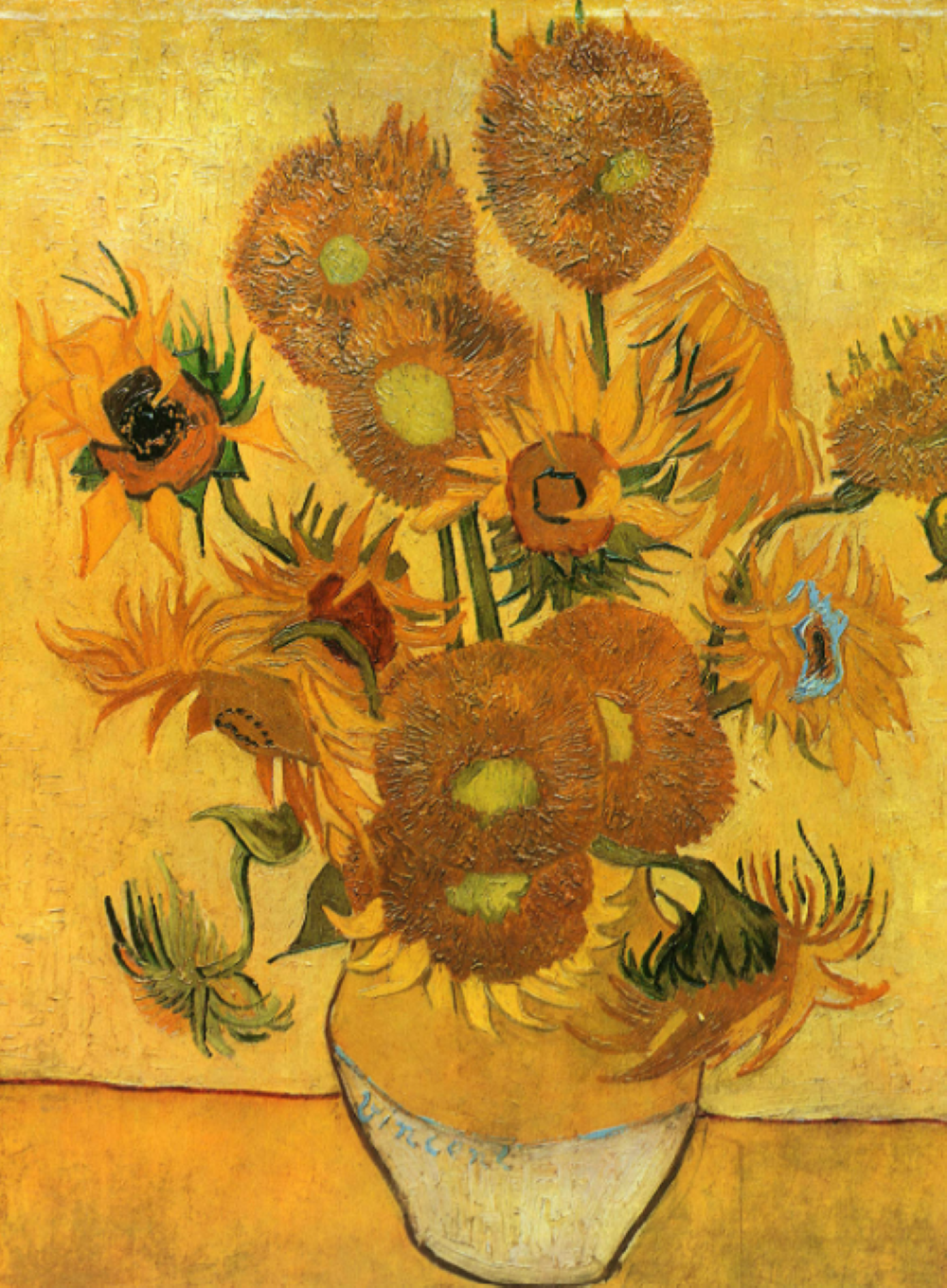
Sunflowers are able in invoke feelings of joy, warmth and happiness and fetch a smile to most onlookers. What is it about this annual summer plant which is so powerful and distinctive? Is it due to the deep inviting shade of yellow, the large, broad-beaming flowerhead or the unusually tall strong stem? Whether it is a solitary giant, a selective bunch or an entire field; it seems that gazing at sunflowers can make you feel good and uplift your soul; a real mood booster for the majority.
The image shown refers to; Sunflowers: Vase of Fifteen Sunflowers by Vincent Van Gogh, Arles, 1888, Van Gogh Museum, Amsterdam, Netherlands.
A sunflower’s purpose is to grow tall and follow the sun, and each summer, millions of sunflowers do exactly that. The Common Sunflower is called Helianthus Annuus, helio meaning sun in Greek and annuus signifying that it is an annual plant. In French they are called ‘tournasols’, in Italian, ‘girasoli’ and Spanish, ‘girasols,’ describing how they turn towards the sun, so they are literally; “sun-turners.”
In ancient Greek mythology, the water nymph, Clytie was so in love with the sun-god, Apollo; she would sit every day gazing skyward to watch her beloved traverse the sky. Sadly, her love was unrequited, so she eventually metamorphosed into a heliotrope – a bright violet flower that follows the sun.
Clytie may have been transformed into a sunflower – but they weren’t around in ancient Greece. It is the Americas where sunflowers originate from, probably over 2000 years BCE in Mexico. Native American Indians understood the vitality of sunflower crops for food and oil and the fact they can grow in poor soil, restore balance and manage to flourish. It was due to Christopher Columbus and his voyage to America in 1492 and the Spanish conquistadors that followed whom we can thank for the import of sunflower seeds, (along with potatoes, tobacco, tomatoes, chocolate, pineapple, etc). It is in the late fifteenth and sixteenth centuries when the sunflower made its way to Europe and beyond.
There is a botanical drawing of a sunflower from 1585 by the Italian Giacomo Antonio Cortuso who was the head of the Botanical Garden in Padua. A research paper was produced in Italy in 2022 called Sunflower: From Cortuso’s Description (1585) to Current Agronomy, Uses and Perspectives, please Google it, if you wish to know more.
The earliest painting I have found featuring a sunflower is from 1632-33; Self-Portrait of an Artist by Anthony Van Dyke – in a private collection.
Van Dyke was a distinguished painter for King Charles I and the royal court in England; he was subsequently bestowed a special gift by the king. In the painting, he features himself working at his canvas, in his finery, but turns his face towards the viewer and shows off the new heavy gold chain around his neck. He has also painted a large golden-yellow sunflower head which seems to protrude out of the canvas. Was this a selfie seventeenth century style? Van Dyke obviously wanted to mark this proud moment by recording his self-portrait as an artist in oil for posterity and I imagine he included the large sunflower to symbolise his happiness and gratitude of the gift.
Van Dyke (1599-1641) was a highly successful and influential Flemish painter who worked in Flanders under the great Rubens and also worked in Italy. He was invited to England and became a distinguished painter for the royal court. Please see more of his talent and brilliant artistry online, like Charles I in Three Positions, Cupid and Psyche, etc.
However, it is Van Gogh (1853-1890) who has become synonymous with sunflowers, famous the world over. In the late 1880s, Van Gogh painted two sets of sunflower pictures, one in Paris 1887 and the other in Arles, 1888-9. Arles is where he had the Yellow House and he wanted to brighten up the room for his friend, fellow artist, Paul Gauguin, who was coming to visit. What a lovely sentiment to decorate a room for your friend, by painting huge smiley yellow sunflowers!
There were new pigments of yellow being developed at the time, e.g., cadmium and chrome yellow and Van Gogh wished to experiment with the yellow spectrum. He also studied and painted the full lifecycle of the flower. Thank goodness he did as we now have his beautiful bold yellow sunflowers to appreciate which hang in art galleries in the UK, Netherlands, USA and Japan.
Many of Van Gogh’s contemporaries also painted sunflowers, whether outdoor or indoor scenes, as still life or with a human figure, although no one else captured such huge, bold sunflowers like Van Gogh. If you sign up for my newsletter, I can send you the full article including my list of sunflower paintings from artists such as; Monet, Caillebotte, Gauguin, Matisse, Schiele, Klimt, Schiele, (and Segal and Mutzner).


