
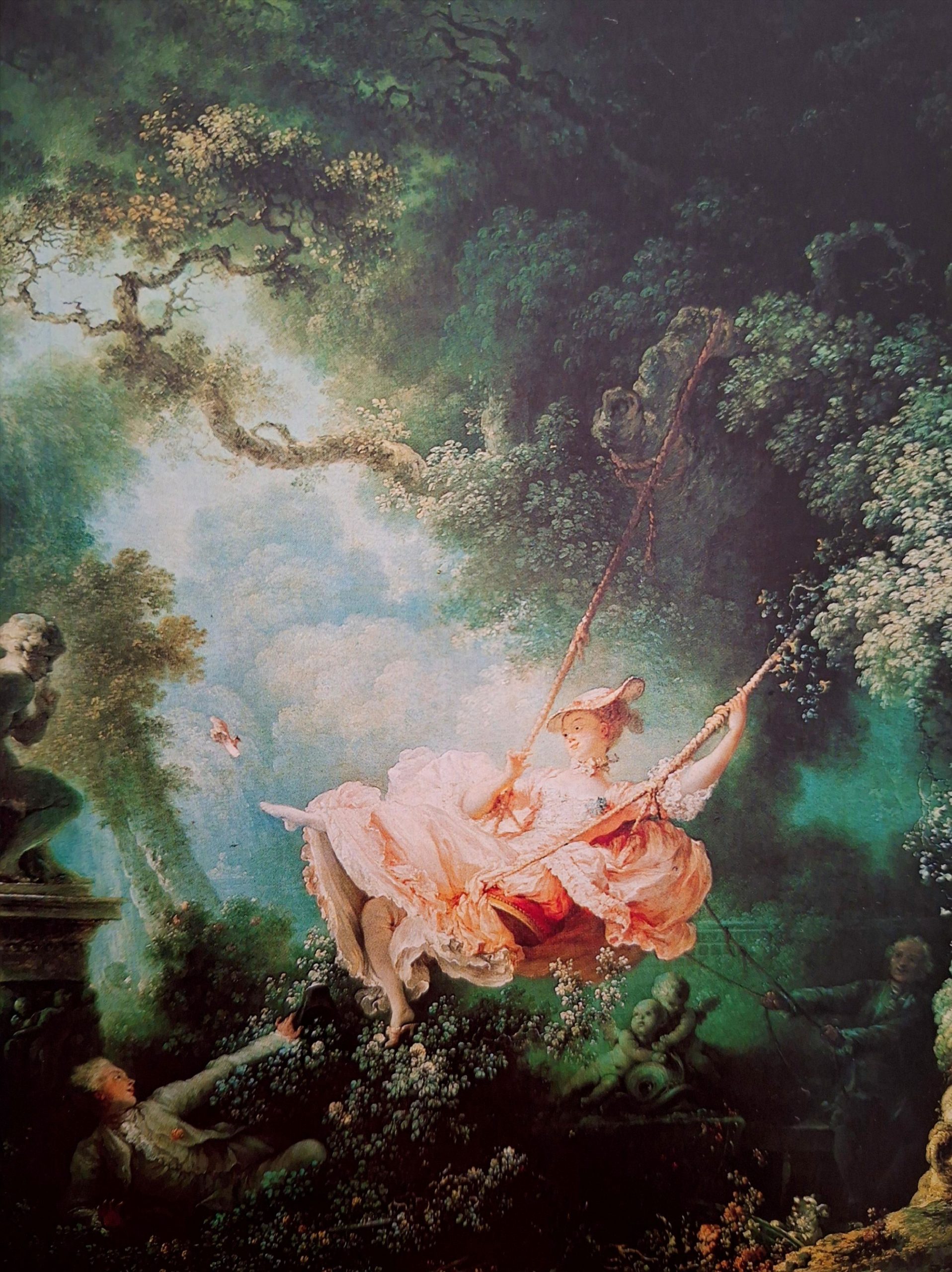
ART – THE SWING BY JEAN-HONORE FRAGONARD (1732-1806)
We encounter different relationships in art and literature that have an impact on the human soul, which hopefully can increase our awareness and understanding of different aspects of the human condition. In this article I have chosen to examine some French relationships expressed in art and literature that cover the romantic, the dangerous and the unfortunate.
The scene above is very romantic and light-hearted, it is the famous rococo painting entitled, The Swing or L’Escarpolette, it’s full titile is, The Happy Accidents of the Swing or Les Hasards heureux de l’escarpolette. We see a beautiful young lady, an aristocrat dressed in her pale pink silk and white lace finery, complete with fashionable bergère or shepherdess hat, throwing caution to the wind as she kicks off her dainty shoe, exposing her slender, silk-stockinged legs, as she enjoys the full movement of the swing in motion.
She sits upon a red velvet gilded swing and is surrounded by ancient trees, some hidden statues, lush summer greenery and dark foliage of a prestigious garden. There is a little cupid at one side gesturing to keep quiet, or ‘keep a secret’ whilst two other little cherub statues, (or putti) behind her, are clinging to each other, looking slightly anxious. When you look closer, you see an old man hidden in the shadows, obscured in the trees. He is pulling the swing ropes, facilitating the movement, (perhaps he is her aging husband who is the cuckhold?). And then in the foreground on the diagonal opposite side, sequestered by the leafy bushes below, there is a handsome and fashionably-dressed young nobleman. His face is highlighted, gazing up at the girl or rather up her skirts with love and admiration; hence the happy accident. The spotlight is on the central figure, the elated smiling sweetheart on the swing, her eyes are transfixed happily on her lover below. Does the old man have any idea what is going on or who is present in the shadows? Is it his little dog barking trying to warn him? I suppose there could be a metaphor here of the girl “swinging” back and forth to her husband and then to her young lover?
The young man is the courtier Baron de St Julien and he commissioned this painting of his young mistress. He approached the famous painter of the time, Gabriel François Doyen, (1726 – 1806) who was associated with serious historical and mythological subjects, but he refused it. Doyen considered the subject matter too frivolous or unseemly and passed the commission onto Fragonard instead. This became one of Fragonard’s most famous paintings and is considered a rococo masterpiece – a happy accident indeed!
Fragonard painted this around 1767-69, during the reign of King Louis XV of France, just prior to Louis XVI’s ascent to the throne in 1774. It is a fine example of rococo art showing the idle rich, idling their time in frivolous pursuits. It is a beautiful painting showing action in free motion and conveys a feeling of flirtation, frivolity romance and high spirits; an example of a liaison ‘romantique.’
Fragonard worked for the royal court as a successful artist and decorator and managed to survive the French Revolution (1789-1799). The painting is relatively small, oil of canvas measuring approximately, 81 cm high by 64 cm wide and is part of The Wallace Collection in London. Please search online if you wish to know more about Fragonard’s work or visit The Wallace Collection yourself or view their website online.
LES LIAISONS DANGEREUSES – NATIONAL THEATRE LIVE
And turning to literature, theatre and film for relationships of a different kind, namely; Les Liaisons Dangereuses which is an epistolary novel from 1782 by Frenchman Pierre Choderlos de Laclos. It was written in the era of King Louis XVI and his wife, Queen Marie Antoinette, prior to the French Revolution. If this novel is a social commentary and reflection of the nobility; it is clear that the rich became highly unpopular due to their excesses, extravagance, and debauched lifestyle, at a time when the populace was starving and oppressed.
In 1985 Christopher Hampton* adapted the novel into a hugely successful stage play, which has been performed many times over the decades. Earlier this year, the National Theatre staged Hampton’s adaptation of the play in London, adding a new twist with dedicated dance choreography, and there is a film of the live show in its entirety by National Theatre Live, at selective cinemas around the country.
This is an outstanding rendition of the stage play portrayed brilliantly by established British actress, Lesley Manville as the scheming Marquise de Merteuil and by the debonair Irish actor, Aidan Turner, (Rivals, Poldark, Being Human) as the rakish but totally reprehensible Vicomte de Valmont.
These two characters are paired magnificently for their word-perfect delivery and expression of emotion. They match each other with their ever-increasing deceit and malice to corrupt their unsuspecting victims; mainly the innocent Cecile de Volanges, (Hannah van der Westhuysen) and the virtuous Madame de Tourvel, (Monica Barbaro). The two protagonists weaponise sex for manipulation and revenge, just for their own satisfaction and amusement. It is directed by Marianne Elliott, set designed by Rosanna Vize, costume designed by Natalie Roar and choreographed by Tom Jackson Greaves. The entire cast, set, production and choreographed dancing all enhance the atmosphere of peril and allure, making this a scintillating, mesmerising performance.
You can check out the original trailer on You Tube to see if this would appeal to you, (contains adult themes). Please access the National Theatre Live website to get up-to-date information regarding where you may be able to watch this film at a local cinema or access the film online.
DANGEROUS LIAISONS
The Hollywood film, Dangerous Liaisons was produced in 1988 starring Glen Close and John Malkovich as the main culprits, alongside Uma Thurman and Michelle Pfeiffer. The film won three of its seven Oscar nominations and a flurry of other awards, including a couple of BAFTAs and received international acclaim. Britain’s Christopher Hampton* won an Oscar for his screenplay.
The film; Cruel Intentions from 1999 was inspired by Hampton’s adaptation with Sarah Michelle Gueller, (of Buffy the Vampire fame), Ryan Philippe, a young Reese Witherspoon and Selma Blair. This was a stylish contemporary interpretation accompanied by an interesting soundtrack of the time. However, I feel both of these films would now appear very dated and have no bearing at all on the National Live Theatre’s film, which is far superior in all respects.
LES MISERABLES
In contrast, turning to relationships of a completely different kind, to see how the ‘other half lived’ or rather the masses, then look to Victor Hugo’s classic masterpiece, Les Misérables from 1862. This novel gives you an insight about how ordinary characters try to find love and survive poverty, injustice and oppression. The novel deals with the aftermath of the French Revolution with the period from 1815 to the 1860s.
If you don’t fancy ploughing through the 1500 pages or so of the brilliant novel, you might appreciate Les Misérables, the Tony Award-winning stage musical, (more like an opera with the continuous singing) which appeared in London’s West End in the early 80s and has been the longest running musical there ever since. It has been performed on Broadway and toured worldwide; over 150 million people have seen the stage show, in 57 countries and in 22 languages; such is the power and impact of the arts. Check out the impressive stats; Les Misérables | The Official Global Website_
Les Mis (as it is affectionately known) is a rousing, moving rendition of Hugo’s masterpiece, featuring some beautiful songs like; ‘I Dreamed a Dream’ (which catapulted Susan Boyle to fame and second place on Britain’s Got Talent in 2009) and who could forget Alfie Boe’s dulcet tones singing; ‘Bring Him Home.’ Credits to the producer, Cameron McIntosh, music from Claude-Michel Schönberg, Herbert Kretzmer for lyrics, original text by Alain Boublil and Jean-Marc Natel and the book by Boublil and Schönberg, according to Les Misérables (musical) – Wikipedia.
The musical was a successful Hollywood film from 2012; check out Hugh Jackman and Russell Crowe with a sterling cast including; Anne Hathaway, Eddy Redmayne, and Amanda Seyfried, with the hilarious Sacha Baron Cohen and Helena Bonham Carter providing the very much needed comic interludes. How on earth did Hugh Jackman not win the Oscar for best actor in his role as Jean Valjean?
PAINTING OF FANTINE 1886
If you go to the Walker Art Gallery in Liverpool or if you search online for this painting, you will see the powerful presentation of Fantine by Margaret Bernadine Hall (1863-1910). Fantine is one of the early characters in the Les Misérables novel who is crucial to the plot. Fantine is dealt a particularly unfortunate hand in life and a trajectory that she never deserved. Her face tells her whole life story; she can’t understand it either.
This stark realism painting from 1886 conveys the sadness and quiet emotional pain. The artist displays meticulous detail, skill and feeling. Fantine’s face is lined, haggard, wearied, and staring out at the viewer with a resigned expression, which is very moving. Fantine’s fair skin and her infant Cosette, clothed in white, suggests an innocence; they are highlighted in contrast against the dark, almost black oppressive background which helps to convey her despair succinctly. I saw this painting several years ago and I felt that the character’s life story and this painting are brutally serious and positively haunting. All credit due to the skill of a painter that could strike such a chord with the viewer. Fantine | National Museums Liverpool


