
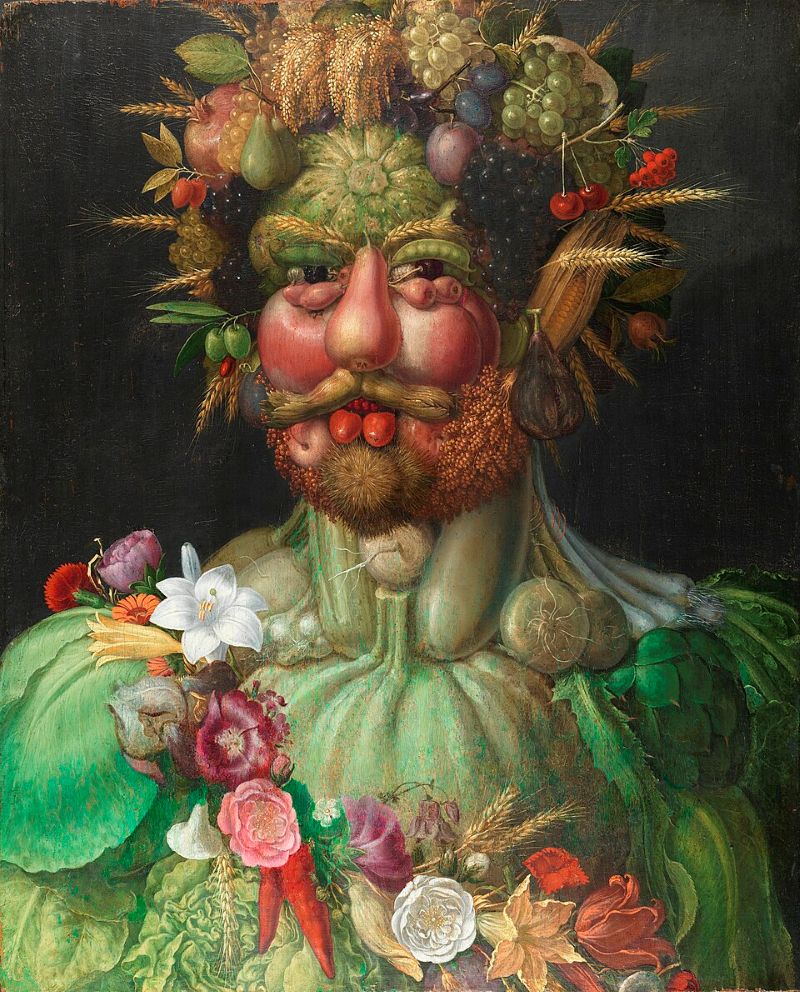
Autumn is the season of the harvest where we can be thankful for abundance. We are surrounded by ripened fruit, berries, nuts and brightly-coloured seasonal vegetables, which brings me to one of my most favourite subjects – food! The Italians have a saying; ‘The Italians live to eat’ and I’ve never met a native Italian yet who isn’t passionate about food.
In honour of the harvest season, I have chosen the image which I’ve dubbed; “Veggie Man.” I am curious to know, at the initial glance, when do you think this picture was painted? I will come back to the painting and the artist later…
I began to think of those old heavy oil paintings where you have a very dark background and the foreground is highlighted in full colour; a dining table set out with a banquet, large fruit bowls, stuffed with all manner of fruit, a couple of newly-hunted pheasants waiting to be plucked, an ornate chalice or candlestick, all set out as a feast for the eyes and then I began to dig a bit deeper.
It is really the brilliance of the Dutch Masters of the 17th Century that we have to thank for mastering this technique of painting a selection of food. Apparently, it was a sign of your wealth and social standing if you could commission a painting demonstrating your abundance and have it hanging in a prominent place, probably the dining area when you were entertaining guests, so they could be reminded of how wealthy and prosperous you were. The Dutch Republic with their magnificent fleet and expanding empire was importing all sorts from other parts of the world; lemons featured greatly as an exotic, sought-after and highly versatile fruit as an example.
When students study art, they are encouraged to paint, “still life.” The word, ‘stilleven’ comes from the Dutch meaning still or motionless. Arranging a bowl of fruit nowadays is something which is easily accessible and you know the fruit won’t roll or run away, giving you time to study the curvatures, the lines, dimples and capture the colours, highlights and shadows, without the subjects moving. Painting fruit and veg is far easier than trying to paint a human figure who will twitch, shift, get bored or alter position and not remain so “still.”
I began to look at various beautiful Dutch paintings from this era and could see many with fruit and game, some with cheese and nuts or fish. Often the goods were placed upon a table, perhaps with a tablecloth, the produce positioned in a delicate porcelain dish or a pewter platter and beside them a brass candlestick or musical instrument. There is another Dutch term, ‘pronkstilleven’ which means ostentatious still life, where you see an abundance of food, fruit and dead game along with precious expensive objects; silver goblets, fine crystal, highly decorated with gold.
The skill to capture the light and shade and the texture of these different materials is truly remarkable. I have sourced several prominent Dutch painters (including two women) who specialised in still life, although there are many more. Some paintings convey an expansive bouquet of many different types of flowers, but most of them include food. As the century progressed these appealing banquet scenes moved to include the ‘vanitas’ meaning that certain objects were included to impart a hidden or symbolic meaning to the viewer. Mainly, this was to allude to the fragility of human life and fleeting earthly pleasures, the passing of time and mortality, (more is explained in my newsletter).
Jan Davidsz de Heem, Abundant Still Life with a Parrot from 1655 is an excellent example of a pronkstilleven painting (Source and credit; Wikimedia Commons and https://www.pubhist.com/w6914) the original can be found in the Academy of Fine Arts, Vienna.
You are welcome to sign up and subscribe freely to my newsletter to see examples of these leading Dutch artists; Jan Breughal the Elder, Willem Claesz.Heda, Pieter Claesz, Jan Davidsz de Heem, Willem Kalf, Rachel Rusysch, Clara Peeters and Frans Snyders. Read about the links between food, music, literature, film and theatre and how Dickens and his novel, ‘Oliver Twist’ is still reaching audiences today, as well as the new Johnny Depp film, ‘Ebeneezer,’ a re-working of Dickens’s classic; ‘A Christmas Carol.’
“Veggie Man” is actually a portrait of Rodolfo II, Holy Roman Emperor as Vertumnus, the Roman god of the seasons from c.1590, painted by esteemed Renaissance painter, Giuseppe Archimboldo. These paintings were dubbed; ‘mannerisms’ and were welcomed in the Renaissance as works which were highly witty, entertaining and intelligent.


